Starbridge vs. e.Republic Industry Navigator: which platform turns government and education signals into closed deals?
Compare Starbridge and e.Republic across buying signals, contact data, spend intelligence, RFPs, and contract vehicles for K–12 GTM teams.

Starbridge vs. e.Republic Industry Navigator comes down to how much of the government and education sales motion you need one platform to handle:
- Industry Navigator is a market intelligence platform from e.Republic, focused on researching government and education IT opportunities across the procurement lifecycle.
- Starbridge is an AI GTM platform that carries a deal across the full government and education market, from the first buying signal to a signed contract.
| Capability | Starbridge | Industry Navigator |
|---|---|---|
| Early buying signals | Proprietary monitoring across 320k+ entities, with scored accounts and drafted outreach | Developing opportunities and intent insights, with meeting signals licensed from Cloverleaf AI |
| Contact and account data | Continuous .gov and .edu crawls, 98% email accuracy, bi-directional CRM sync | Agency profiles, verified contacts, and CRM integration |
| Vendor spend intelligence | Full competitor contracts and unredacted proposals through FOIA automation | Award data, purchase order data, and vendor history |
| RFP finding and response | Scored, personalized RFP feed plus full AI proposal drafting | RFP database with Navi and Chat with RFP for bid analysis |
| Contract vehicle access | Available as part of the platform, with compliance and renewals handled directly | Contract vehicle access is not part of the offering as of September 2026 |
Spotting early buying opportunities from data sources
A buying signal is an early sign that a school district, university, or state or local agency is planning to spend, such as a new grant, a budget line item, or a contract about to expire.
These surface often months before an RFP ever appears. The data sources behind a platform decide whether your team engages while it can still shape the opportunity.
Starbridge surfaces buying indicators from board meetings, budgets, grants, leadership changes, and more
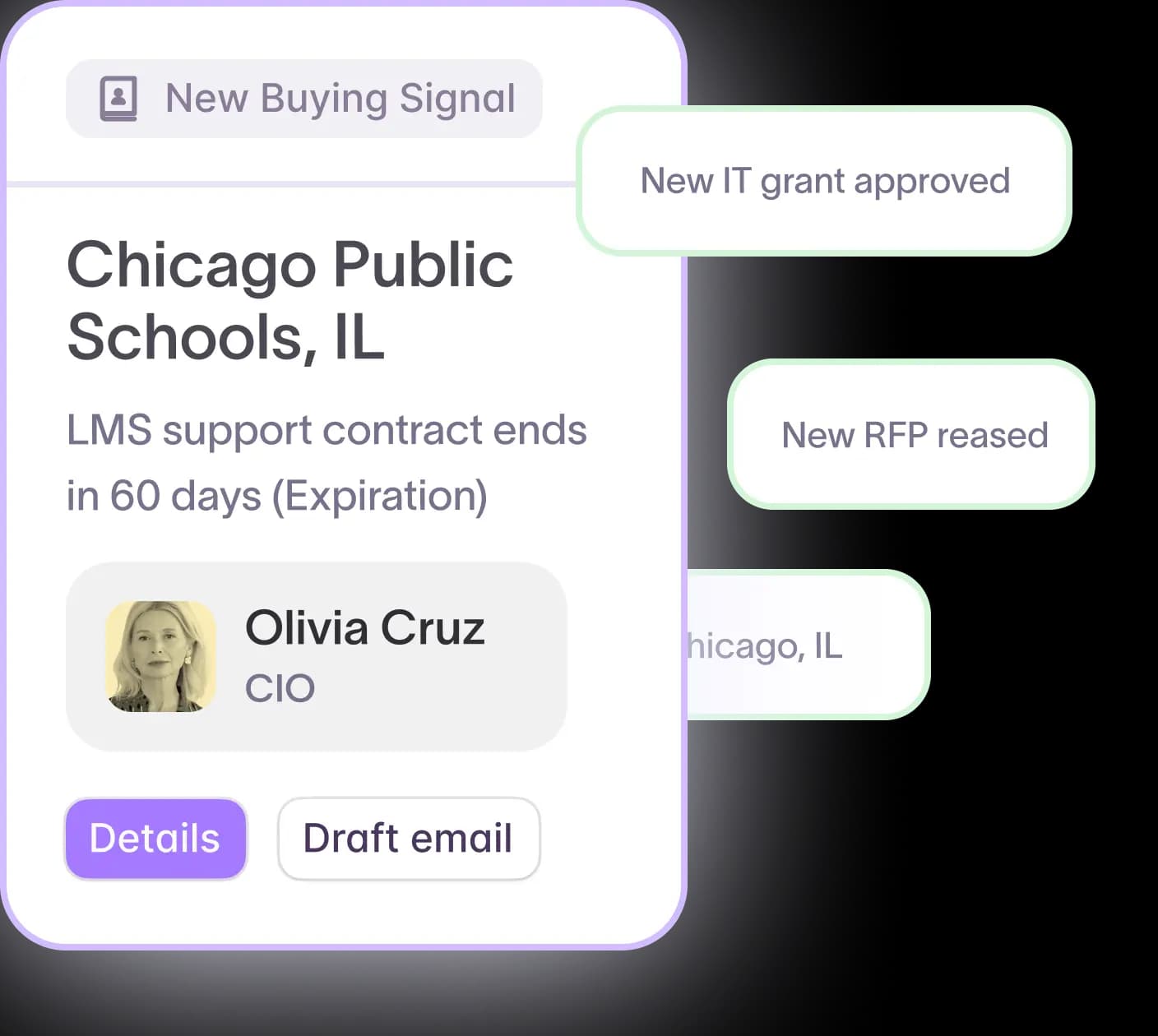
Starbridge is built around the Buying Signal Monitor, a proprietary signal engine that watches 320k+ government and education entities around the clock. It reads board meeting minutes, budget releases, grants, leadership changes, and contract expirations, with bids and RFPs treated as the last signal rather than the first. Because the infrastructure is proprietary and owned end to end, every account is scored on its own buying readiness rather than pulled from a single licensed feed.
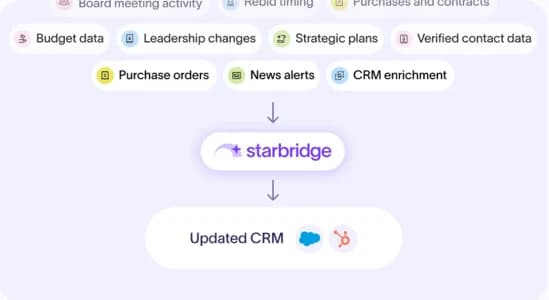
The engine powering the Buying Signal Monitor uses semantic search that reads context, not just keywords. This means a budget shortfall or a capital project surfaces as a buying indicator on its own, even when nobody typed the phrase a rep was searching for.
Every Starbridge signal arrives with a verified contact, a reason the timing is right, and AI-drafted outreach copy pushed directly into Salesforce, HubSpot, Apollo, and Outreach. Reps act on the same day instead of returning to a dashboard to figure out a next step.
GovWell booked five meetings in its first week on Starbridge, and now sources 15% of qualified leads directly from Starbridge.
Industry Navigator surfaces developing government IT opportunities and intent insights
Industry Navigator is a market intelligence platform that covers developing opportunities, intent insights, and budget and funding signals across the government and education IT procurement lifecycle.
The platform also surfaces grants intelligence, jurisdiction profiles, and IT strategic plans, so teams can research an agency before an opportunity formalizes. Its meeting-signal layer is licensed through an exclusive partnership with Cloverleaf AI, which brings meeting intelligence into the platform.
The platform centers on IT opportunity discovery for teams selling technology into government. Industry Navigator’s lifecycle view spans early signals, active bids, and awarded contracts, giving researchers one place to track how an opportunity develops.
The bottom line
Industry Navigator gives teams a strong view of developing government IT opportunities, using its broader SLED dataset alongside a licensed meeting-signal feed. Starbridge owns its signal infrastructure directly, scores each account, and routes every indicator with a verified contact and a next step.
That closes the gap between a research feed and outreach a rep can act on the same day. For teams that want signals to translate directly into conversations, that end-to-end loop is the deciding factor.
Contact and account enrichment that stays current
What matters most in contact data for this market is freshness and accuracy.
Government and education leaders keep sparse public profiles and change roles often, so records go stale quickly. Databases that draw heavily from LinkedIn and commercial sources also reach this market poorly, which leaves reps emailing people who left the role two years ago.
Starbridge delivers 98% email accuracy from continuous .gov and .edu crawls
Starbridge delivers its Contacts & Company Data based on continuous crawls across .gov and .edu sites, backed by waterfall enrichment and ongoing bounce-checking.
The result is 98% email accuracy, validated across a 14,000-email test, with a 2% bounce rate.
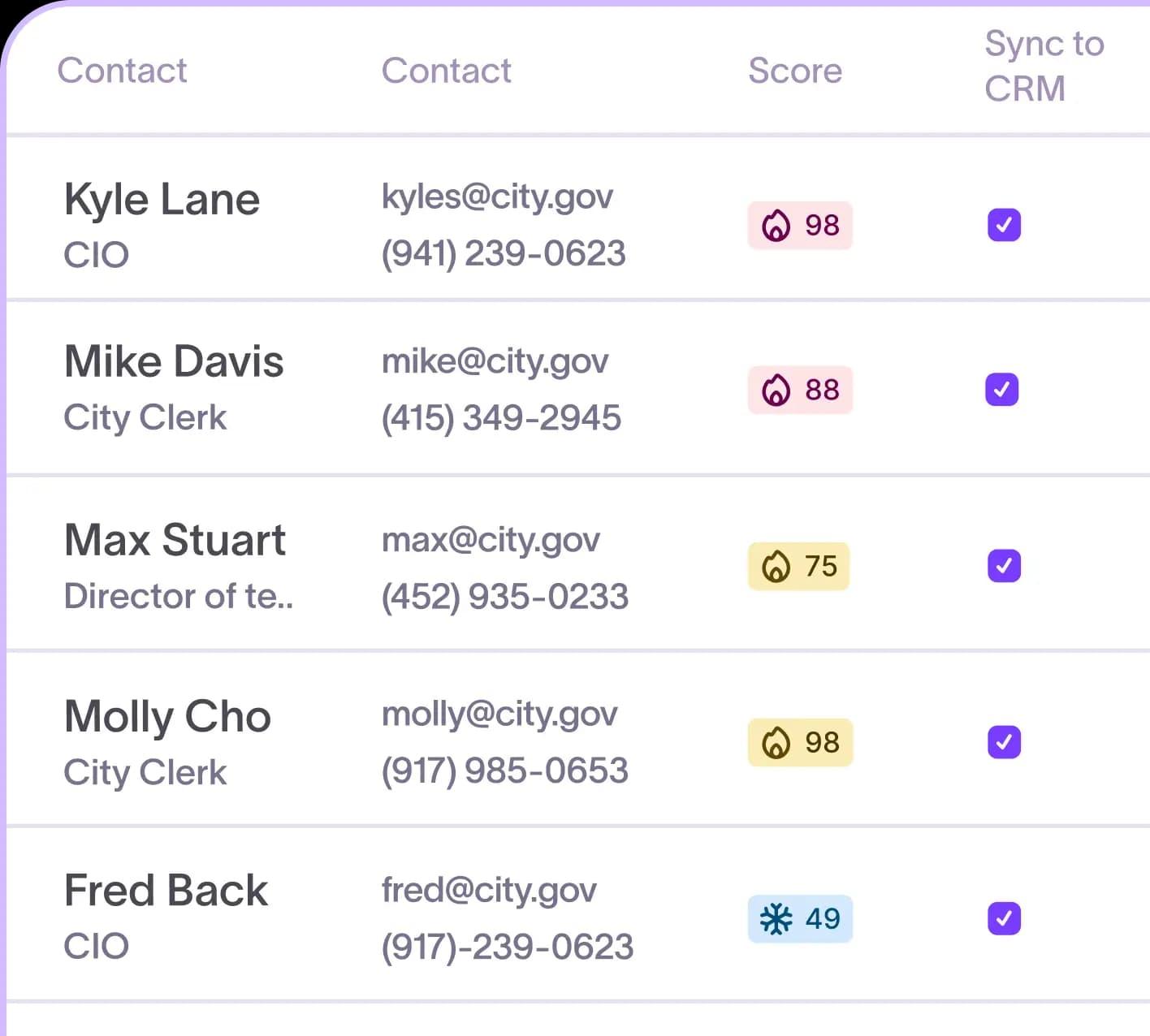
Contact databases that rely on LinkedIn and commercial sources typically see bounce rates of 15% to 25% on unfiltered exports, a meaningful issue when you prospect a finite market where sender reputation matters.
But clean data only helps if it reaches the tools reps already use.
That’s why Starbridge offers native, bi-directional Salesforce and HubSpot integrations that sync, clean, and enrich records automatically.
Dynamic account scoring then surfaces the warmest accounts with the context behind them, and AI positioning briefs tie your features to the specific pain each buyer is facing.
Accurate data is what lets reps skip manual verification and get straight to selling. Bobby Offterdinger, CEO & Founder of TAM to Target, says, “Starbridge data is literally 4 to 5 times more valid than any other source.”
InquirED generated $200K in new pipeline in its first quarter by replacing manual board-document research with signal-driven account scoring that flagged which districts were ready to buy.
Industry Navigator provides agency profiles, verified contacts, and CRM integration
Industry Navigator delivers jurisdiction profiles, agency priorities, and verified contact data for key decision-makers as part of its market intelligence. It also supports CRM integration.
For teams researching who sits where across agencies, that profile view gives useful context heading into an account.
The bottom line
Both platforms help reps understand the agencies they sell to. Starbridge continuously verifies and scores contacts, then pushes an enriched database into the CRM with the specific reason each account matters right now.
That ongoing verification keeps records from drifting out of date in a market where roles turn over quickly. For a team that lives in Salesforce or HubSpot every day, that live enrichment is the practical dividing line.
Understanding vendor spend across government and education
Vendor spend intelligence tells you what an account already buys, who it buys from (for example, a potential competitor), and when those contracts come up for renewal.
That visibility can help sales teams with prioritization, displacement, and discovery prep.
Starbridge runs FOIA automation to surface full competitor contracts, not just line items
Starbridge powers Public Spend Intelligence with FOIA automation that surfaces full competitor contracts and unredacted vendor proposals at scale. Out of the box, Starbridge has purchase order data for 77% of state and local government, K–12, and higher education institutions.
That combination gives reps both the breadth of purchase order coverage and the depth of the contract behind it.
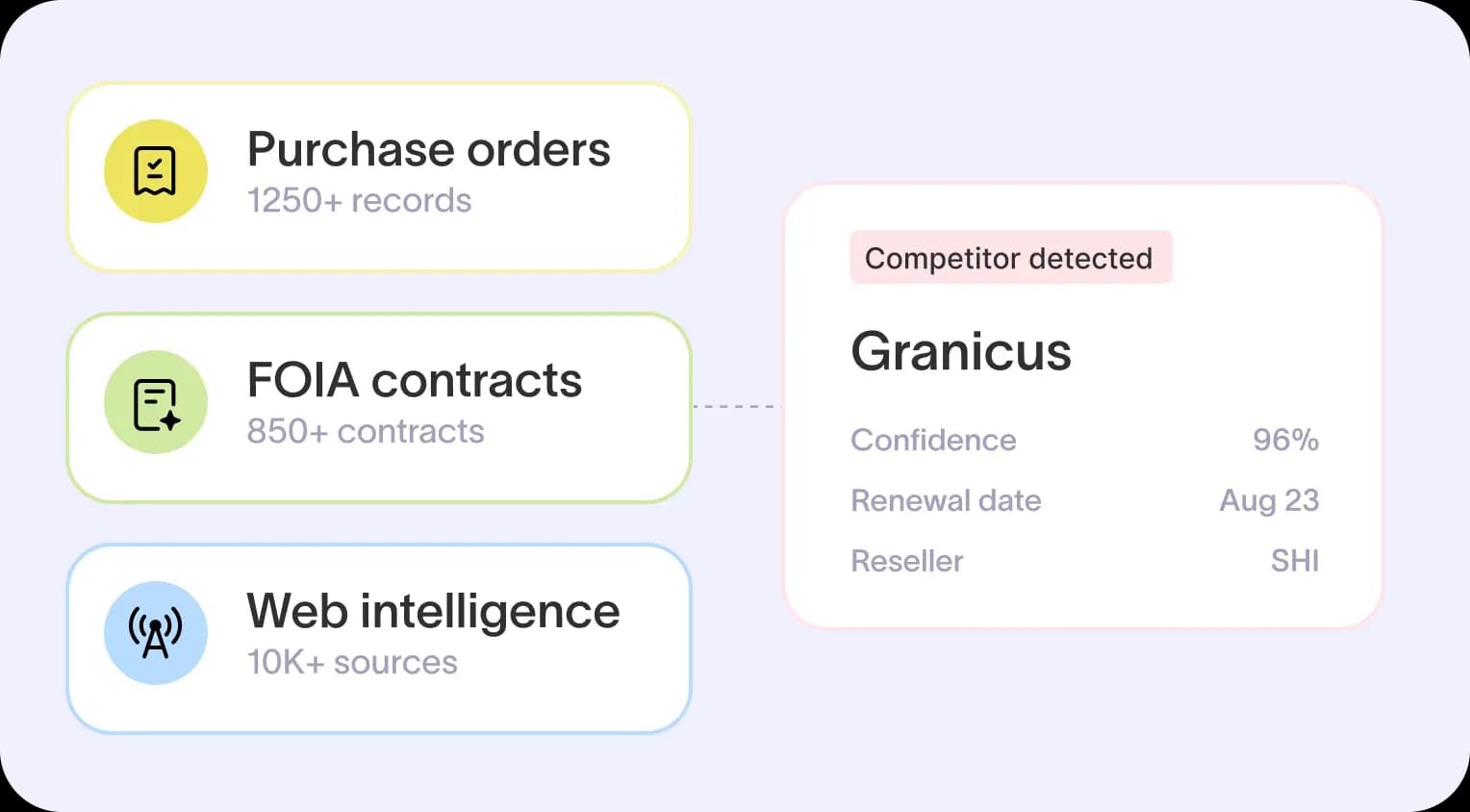
Starbridge also surfaces annual revenue, the full proposal, opt-out clauses, implementation fees, expiration dates, and revenue by product. A rep can walk into discovery already knowing what a prospect pays an incumbent, when the contract expires, and how to position against it.
That automatic sales call preparation can save hours on a rep’s calendar every week.
Frontline Education cut research time by 90%, turning what used to be two hours of account digging into five minutes.
The same time savings show up on larger, more complex teams. Abnormal AI cut research time by 10 hours a week by centralizing spend and signal intelligence its reps once gathered from scattered sources.
Industry Navigator provides award data, purchase order data, and vendor history
Industry Navigator covers award data, purchase order data, term contracts, and vendor history across the government and education IT lifecycle. For teams tracking who won which contract and when a term contract ends, that record gives a clear map of past procurement activity.
The bottom line
Industry Navigator provides award, purchase order, term contract, and renewal data. Starbridge adds full-contract depth, including pricing, opt-out clauses, implementation detail, and expirations reps use for rip-and-replace campaigns.
The Starbridge platform shows not only that a contract exists but when and how to displace it, which can be the difference between mere research and actual revenue.
Finding and responding to RFPs
RFP discovery and response is where many government and education deals are won or lost.
Buyers aren’t experts in the solutions they need, so they consult vendors early in the purchasing process (often months before an RFP) to learn what is possible. The vendor who educates the buyer usually shapes the evaluation criteria.
By the time an RFP is published, that shaping has often already happened.
Starbridge scores RFPs for fit and drafts full proposals with AI
Starbridge runs the AI RFP Finder & Proposal Writer, which pulls thousands of bid portals into one personalized feed scored by fit, region, and win likelihood. Reps don’t need to scan portals and can start immediately on the opportunities most worth pursuing.

The platform goes beyond finding bids to helping teams respond. A full AI proposal writer drafts from your product knowledge base, a compliance matrix builder maps requirements, and a collaboration mode lets the team comment and refine. This means the time to respond to RFPs decreases, because teams don’t need to do repetitive drafting.
It’s important to note that RFPs are best understood as the last buying signal, not the first. Starbridge puts heavy emphasis on earlier indicators, so an RFP from a target account doesn’t come as a surprise.
Industry Navigator offers an RFP database with Navi and Chat with RFP for bid analysis
Industry Navigator provides RFPs, RFQs, bid documents, and opportunity alerts across the procurement lifecycle.
A May 2026 relaunch introduced Navi, a conversational AI agent for natural-language queries, and Chat with RFP supports AI-assisted bid analysis and bid or no-bid decisions. For teams that want to interrogate a dense bid document quickly, those tools speed up the read and help score requirements against fit.
The bottom line
Industry Navigator helps a team read and analyze a bid with Navi and Chat with RFP. Starbridge goes further, scoring each RFP by win likelihood and drafting the full proposal in-platform.
That shifts a rep from reading a bid to responding to it without leaving the tool. For teams measured on how many best-fit RFPs they win rather than how many they read, that full workflow is the deciding factor.
Contract vehicle access that removes procurement friction
Contract vehicle access is the path from vendor of choice to a signed, compliant purchase order.
The right cooperative purchasing vehicle can let an eligible agency buy without a new full RFP, subject to contract scope and ordering requirements, which can cut months out of an already-won deal. For many teams, this is the stage where a yes stalls for a quarter or more.
Starbridge provides contract vehicle access as part of the platform
Starbridge provides Contract Vehicle Access directly as part of the platform and handles the compliance, paperwork, and renewals itself.
Teams onboard once, then use the right vehicle on every deal. That includes NASPO ValuePoint, OMNIA Partners, Sourcewell, TIPS, and GSA, among others. Direct access removes the multi-year wait most vendors face when trying to get on these vehicles on their own.
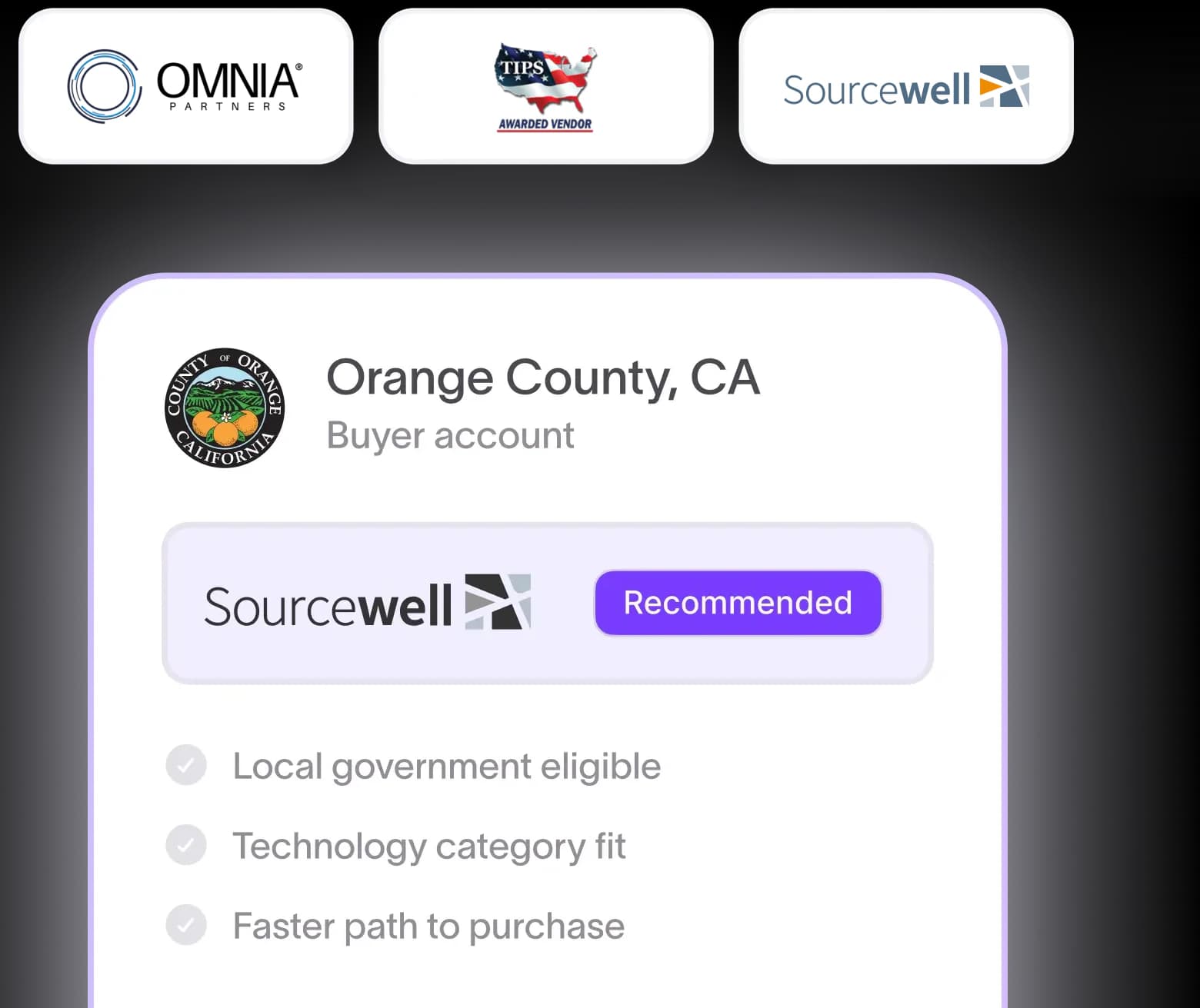
Knowing which vehicle a buyer uses is half the battle. The Navigate Procurement tool surfaces the exact vehicle each buyer purchases through, shown right on the buyer’s page, so reps do not have to guess.
Contract vehicles allow sellers to significantly accelerate the procurement stage, which shortens sales cycles and frees up cash earlier.
Industry Navigator focuses on market intelligence across the procurement lifecycle
Industry Navigator centers on market intelligence and opportunity research across the procurement lifecycle. Contract vehicle access is not part of the offering as of September 2026. For teams whose main need is understanding the market and tracking opportunities, Industry Navigator’s research focus is a clear and coherent scope.
The bottom line
Industry Navigator helps a team research the market and track opportunities. Starbridge carries the won deal through procurement to a signed contract, all in one platform.
That extension closes the gap between a buyer’s yes and a signed agreement. For a team that keeps losing time between a verbal yes and a paid contract, that final step is where the platforms diverge most.
Which platform is right for your government and education GTM team?
If your team mainly needs opportunity research and lifecycle tracking for government and education IT, a market intelligence subscription like Industry Navigator may be enough on its own. It gives sales and marketing teams a strong view of developing opportunities, agency priorities, and past procurement activity.
Starbridge fits GTM teams that want the full motion in one platform.
It detects intent early, hands reps verified decision-makers, and surfaces competitor contracts. It also scores and drafts RFP responses, then closes through the right contract vehicle. All of it pushes into Salesforce, HubSpot, Apollo, and Outreach, and the payoff for GTM leaders is more meetings with the right decision-makers, earlier, without growing headcount.
If you’re ready to win more government and education deals with a single connected workflow, book a demo and see how Starbridge fits your team’s motion.
Frequently asked questions
Starbridge is the strongest fit for teams that want to carry a deal from an early buying signal to a signed contract in one platform. It pairs proprietary buying signals with verified contacts, competitor spend intelligence, RFP tooling, and contract vehicle access. Industry Navigator is a good fit for teams that primarily need market intelligence and opportunity research across the government and education IT procurement lifecycle. The right choice depends on whether you want research on its own or a full go-to-market motion.
Look for coverage across five capabilities: early buying signals, verified contact and account data, vendor spend intelligence, RFP finding and response, and contract vehicle access. The strongest platforms connect these as one end-to-end workflow rather than a set of separate reports. A tool that covers only one or two areas leaves your team stitching together research, enrichment, outreach, and procurement by hand. Starbridge runs all five as a single motion, from the first buying signal to a closed deal.
Contact data for this market goes stale faster than commercial data, because government and education leaders keep sparse public profiles and change roles often. Starbridge addresses this by crawling .gov and .edu sources continuously and bounce-checking every record, rather than leaning on LinkedIn and commercial data that reaches these buyers poorly. That approach keeps emails deliverable and titles current in a finite market where a bounced send can hurt the sender’s reputation. The result is a contact database reps can trust the day they open it, instead of one they re-verify by hand.
Pre-RFP timing matters because buyers consult vendors early to learn what is possible, and the vendor who educates them usually shapes the evaluation criteria. By the time an RFP drops, a vendor may have already significantly influenced the buyer’s requirements. Starbridge surfaces early buying indicators like board discussions, budget line items, and contract expirations, so reps engage while they can still shape the opportunity. Waiting for a published bid usually means responding to criteria a competitor already helped write.
Starbridge is designed to shorten the time between a qualified buyer and a signed contract. Even after a buyer says yes, a deal can stall for months in procurement, and contract vehicle access gives buyers a pre-approved path to purchase without a full RFP. Starbridge provides that access as part of the platform and handles the compliance, paperwork, and renewals directly. Industry Navigator does not publicly state contract-vehicle sell-through as a capability as of September 2026, so its focus stays on opportunity research.
Starbridge fits teams from 10-person startups to enterprises with headcounts of 1,500+, as long as selling to government and education is a real motion rather than an afterthought. Pricing sits at a premium and is scoped to each team, which reflects the depth of data and workflow. For lean teams, the value shows up in hours returned, since reps automate research, enrichment, and outreach instead of building lists by hand. Smaller teams often see the fastest payback, because every recovered hour goes straight back into selling.
Explore our use case library
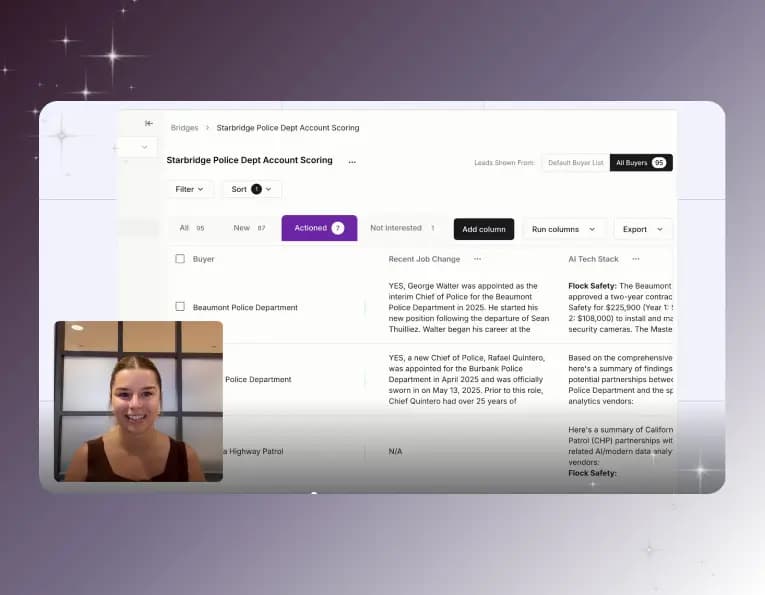 Automate account research with AI agentsStop manually researching accounts. Starbridge AI agents automate account research by monitoring buying signals 24/7 and surfacing the right contacts.
 Identify competitor contract expiration datesThe RFP is usually a formality. Starbridge surfaces competitor contract expiration dates so your reps reach accounts before the renewal cycle closes.
 Create a conference campaignTurn conference badge scans into pipeline. Import your contact list, surface buying signals across every account you met, and follow up with context.